Reference Architecture · v6
A Reference Architecture for AI-Era Media
The model layer commoditizes. The substrate underneath accumulates value. This is the map of where the value goes, the architecture I have been circulating privately with founders, operators, and standards bodies, now public.
- 8 Layers
- 2 Spines
- 5 Clusters
- Free PDF
The Reader’s Guide
Get the Reader’s Guide
The full architecture as a print-quality PDF. Add your email and I will send it. You can read and cite the overview below without signing up.
Want to talk it through? Email me.
What’s In It
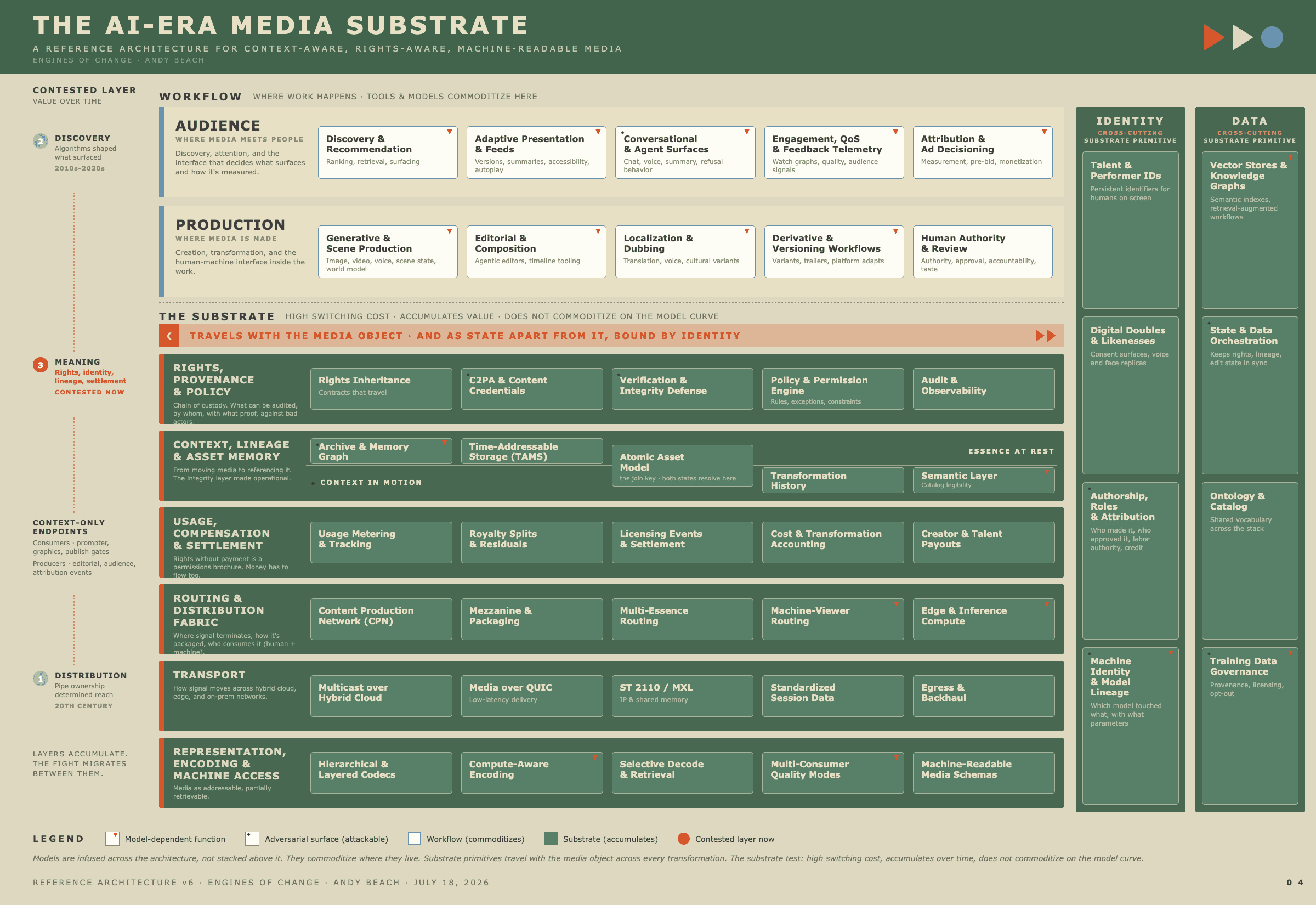
A surface plane, six substrate layers, two spines.
Strip media work down and it does three things. It makes the thing, it moves the thing, and it establishes what the thing means: who is in it, who made it, who it belongs to, and what may be done with it. That is the surface, where the work happens and where the AI tooling lives. It is also where value commoditizes fastest. A new model arrives, vendors integrate it within a quarter, the headline price falls, and the buyer swaps one supplier for another without anything downstream noticing. Those three are make, move, and mean.
Make and move commoditize. Mean is the seam. It is where the workflow hands off to something that runs by other rules.
Rights, identity, and settlement are the doorway between the surface and the substrate, where value stops dispersing and starts to accumulate.
Above the seam, tools turn over. Below it, value stays put.
- Rights, Provenance & PolicyWho may use this, on what terms, provable later.
- Context, Lineage & Asset MemoryWhat the object is, where it came from, every transformation it has been through. At rest with the media, and in motion above it.
- Usage, Compensation & SettlementWhat gets metered, and how money moves through the same primitives that carry the rights, in both directions.
- Routing & Distribution FabricHow the object reaches its destination, human or machine, without losing context at the edge.
- TransportHow reliably the bits arrive. The carriage tier under everything above it.
- Representation, Encoding & Machine AccessHow the object is encoded so both networks and machines can read it.
Two spines run vertically through every layer. Identity carries talent IDs, digital doubles, authorship, machine identity, and model lineage. Data carries vector stores, knowledge graphs, state orchestration, ontology, and training-data governance. They are primitives the whole architecture depends on, so they cut across it rather than sitting in one place.
The substrate travels with the media object. They ride with it. And it keeps a second tempo, state that moves apart from the object, bound to it by identity.
structure only · the full architecture is in the Reader’s Guide.
Five clusters make it navigable.
Knowledge
The model that queries your knowledge graph is replaceable, the graph is uniquely yours. The join lives here too, the Atomic Asset Model, where the two states of memory meet.
Trust & Integrity
Whether a frame can be trusted in court, in a rights dispute, or in front of an audience. A claim that travels apart from the content has to be as verifiable as one embedded in it.
Rights & Compensation
Rights without compensation is a permissions brochure, so money flows through the same primitives that carry the rights. Same rails, both directions.
Identity & Personhood
Who is on screen, who approved it, who gets paid, which model did what.
Standards & Interoperability
The thread that keeps the substrate neutral, so vendors compete on what they build rather than on switching cost.
Why Now
The fight has moved.
- 20th centuryDistributionOwning the pipe decided reach.
- 2010s–2020sDiscoveryThe algorithm decided what surfaced.
- NowMeaningRights, identity, lineage, and settlement are the load-bearing primitives.
Layers accumulate. The fight migrates between them, and it has arrived at the substrate.
One architecture, three lenses.
Operator
a capability map
Which tiles you touch, where you are exposed, where your fight is.
Vendor
a positioning map
Which tiles you serve, and which standards bodies sit between you and what comes next.
Strategist
a power map
Where value accumulates, and what will be obvious in 2030 that is not obvious now.
The architecture does not change. The lens does. The fight does.
The Architecture
The whole substrate, one diagram.
The Reader’s Guide is more readable. Add your email above and I will send it.
Read the Essay
Video as a Data Type.
The longer read, on the Engines of Change Substack.
Read on Substack →About
Andy Beach has spent two decades at the infrastructure layer of media, from the early days of streaming to AI-era production. He was Worldwide CTO for Media and Entertainment at Microsoft and now advises companies on media infrastructure, AI orchestration, and open standards. He writes Engines of Change and hosts the Future Frames podcast.